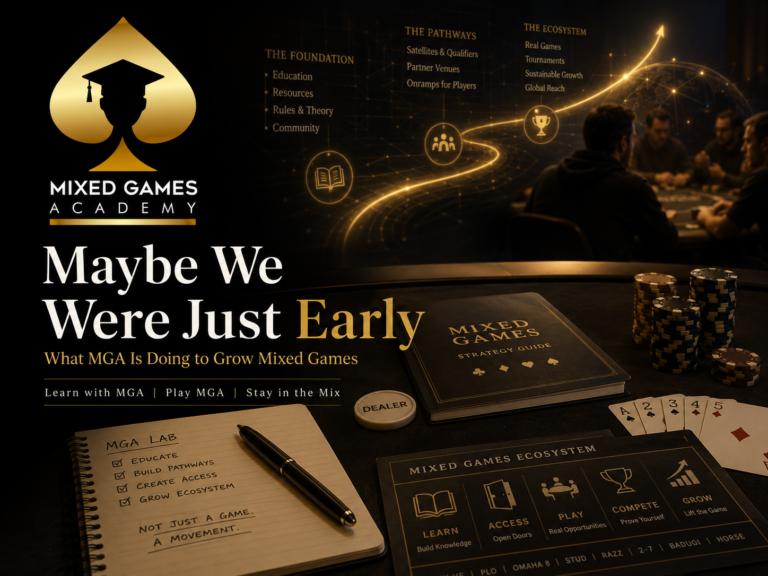
Maybe We Were Just Early: What MGA Is Doing to Grow Mixed Games

Someone asked me recently:

“What are you doing to increase mixed games awareness and teach people to play?”

There was another question sitting underneath it.

Was it my responsibility to teach the market how to play mixed games?

Apparently, yes.

I’ve never completely agreed with that premise.

I’ve always believed that if you have to drag someone off the couch to try something, there’s a fair chance you’ll have to keep dragging them back.

At some point there has to be curiosity.

Self-motivation.

An intrinsic desire to learn something new, improve at it and come back for more.

But the question did get me thinking.

Because we’ve been here before.

When Nobody Turned Up

Years ago, before some of my poker events, I offered free 90-minute seminars immediately before registration.

The idea was simple.

Come in early.

I’ll teach you the games.

We’ll go through the basics, objectives and mechanics.

Then, if you’re comfortable, stay and play.

Nobody turned up.

Not one person.

At around the same time, I would regularly hear:

“No one plays mixed games.”

Maybe they were right.

Or maybe I was just too early.

Because the conversations I’m having now sound very different.

They usually start something like this:

“You know what Prince, you should…”

Or:

“Hey Shannon, have you thought about doing…”

Or:

“If you did this…”

Or:

“I think MGA should…”

And I genuinely appreciate those conversations.

They come from people who are starting to see what I’ve believed for a long time.

There is a future in mixed games.

What most people don’t see are the hundreds of hours already being put in behind the scenes.

So I went back into the Lab.

Forget that nobody came to those seminars years ago.

Forget whether the market was ready then.

Assume we were simply early.

Build for the market we believe is coming.

And start delivering.

Free Mixed Games Education

One of the first things we did was revisit the idea that had failed all those years ago.

A free mixed-games seminar followed by a freeroll.

This time?

More than 50 people turned up to learn.

That meant something to me.

Same idea.

Different time.

Different market.

The interest is there now.

People want to understand these games.

The job is to give them somewhere to start.

“Do You Understand the Game?”

Not everyone wants their first lesson to happen while sitting at a poker table.

So we built something people could work through at home.

Do You Understand the Game? is MGA’s beginner guide to mixed-games poker.

It covers the basics of the games, objectives, gameplay, betting structures, common traps and practical tips for players starting their mixed-games journey.

Eight copies have sold already.

That might not sound like an enormous number.

To me, it represents eight people who actively decided:

I want to learn this.

That matters.

Because sustainable growth doesn’t come from dragging people into something they don’t want to do.

It comes from curiosity.

One interested player becomes two.

Two become a table.

A table becomes a game.

That is how a market grows.

📚 Get “Do You Understand the Game?”: Click here.


Making Mixed Games Easier to Enter

Education is only half the equation.

At some point, people need somewhere to actually play.

One of MGA’s biggest innovations has been the Cruise Pool.

It allows players entering at different buy-in levels to compete together in the same tournament while playing for separate prize pools. Same games | Same chips | Two prize pools

That solved part of the accessibility problem.

But I still felt our standard Main Deck buy-ins could be a stretch for someone who simply wanted to dip their toes into mixed games.

So September is different.

Throughout The September Run, we’re creating genuine lower-cost opportunities to get involved.

Every Thursday there is a $200 option to come and play mixed games.

Come in.

Play.

Ask questions.

Use the resources.

Get repetitions.

Become comfortable with the games.

Then decide whether you want more.

That is a much better pathway than telling someone they need to jump immediately into a major mixed-games event.

Satellite Pathways Into Bigger Events

We’re also introducing more satellite opportunities around selected larger buy-in events.

Not everybody needs to walk through the front door.

If someone wants to play a bigger MGA tournament but doesn’t want to commit the full buy-in, satellites create another path.

Earn the seat.

Then take your shot.

The more ways we can give interested players to participate, the healthier the ecosystem becomes.

A Free Cheat Sheet You Can Actually Use

One of the barriers to mixed games is simple:

There’s a lot to remember.

Different hand rankings.

Different betting structures.

Different drawing rules.

Different split-pot concepts.

Different objectives.

Expecting a new player to memorise every detail before they are “allowed” to sit down and play makes very little sense.

So we created the free MGA Mixed Games Cheat Sheet.

And during The September Run, newer players can actually have the cheat sheet with them while they play.

That is intentional.

You don’t need to know everything on Day One.

You need enough information to participate, somewhere supportive to play and the willingness to learn.

The rest comes with repetitions.

📋 Download the FREE MGA Mixed Games Cheat Sheet: Click here.

Mixed Games Video Course

Next on the production line is video.

A structured mixed-games video course is currently under construction. 🚧

This will give players another way to learn the games visually and work through them at their own pace.

It is a substantial project.

We’re doing it anyway.

Because different people learn differently.

Some will read.

Some will watch.

Some need to sit at a table and play hands.

MGA should be able to provide all three.

Building Rules for the Games We Actually Play

Education and tournament access aren’t the only pieces being developed behind the scenes.

Tournament operations matter too.

I’ve spent an enormous amount of time developing the MGA rules framework for situations where standard TDA rules are silent or don’t adequately address the mixed games we play.

Those decisions are not based on sitting in a room and guessing what seems right.

These games already have history.

They have established practices.

They have decades of knowledge behind them.

The job is to find that history, understand why things were done a certain way and then apply a modern tournament-operations mindset.

Research it.

Test it.

Make it practical.

Make it consistent.

Then make sure players and dealers know what to expect.

That work isn’t particularly glamorous.

Most players will never see the hours involved.

They will simply experience a tournament where the rules make sense and decisions are consistent.

That’s the point.

I Build Tournaments I Would Want to Play

Mixed Games Academy isn’t about inventing strange poker games for the sake of being different.

I play these games.

I love these games.

And when I build a game mix or tournament structure, I build something I would genuinely want to sit down and play myself.

One of the biggest principles behind MGA tournament design is simple:

I want you playing poker.

I want stacks that allow you to grind.

I want structures that give people time to understand the games.

I want experienced players to have enough depth for skill to matter.

I want newer players to survive long enough to actually learn something.

I want affordable pathways for people who aren’t ready for the bigger buy-ins.

I want learning resources for people who want to improve.

And I want serious mixed-game players to have tournaments worthy of them too.

Where other poker formats can increasingly become built around how quickly a player might need to reach back into their pocket, my preference is different.

Give people chips. Give them time. Let them play.

Mixed games don’t grow simply because somebody puts HORSE or 10-Game on a tournament schedule.

You need an ecosystem around them.

Education.

Accessible entry points.

Satellites.

Resources.

Rules.

Dealers.

Structures.

Content.

And, most importantly, opportunities to actually play.

That’s what we’re building.

Is Anyone Actually Playing?

There is another question that sometimes follows all of this:

Is the interest actually translating into players?

The MGA Mob archive tells that story better than a handful of cherry-picked statistics ever could.

The events, players and results are there for anyone who wants to look through them.

I don’t think this article needs a collection of numbers frozen at one point in time.

The more important point is that the ecosystem is becoming real.

People are learning.

People are playing.

People are returning.

And new players are appearing.

That matters more to me than producing a statistic simply because it looks impressive in a paragraph.

Maybe We Were Just Early

So when someone asks me what MGA is doing to grow mixed games, this is the answer.

We’re putting in the reps.

Some of them are public.

A hell of a lot of them aren’t.

Years ago I offered people a free seminar and nobody turned up.

Recently, more than 50 people walked through the door specifically because they wanted to learn mixed games.

That tells me something.

Maybe those empty seminars weren’t proof that nobody wanted mixed games.

Maybe we were just early.

The market feels very different now.

Mixed Games Academy intends to keep educating, experimenting, building pathways and creating the tournaments I believe this part of poker deserves.

Because ultimately, nobody can force somebody to fall in love with mixed games.

What we can do is make sure that when their curiosity kicks in, there is somewhere for them to learn.

Somewhere for them to start.

And somewhere for them to play.

Learn with MGA | Play MGA | Stay in the Mix

Comments are closed.